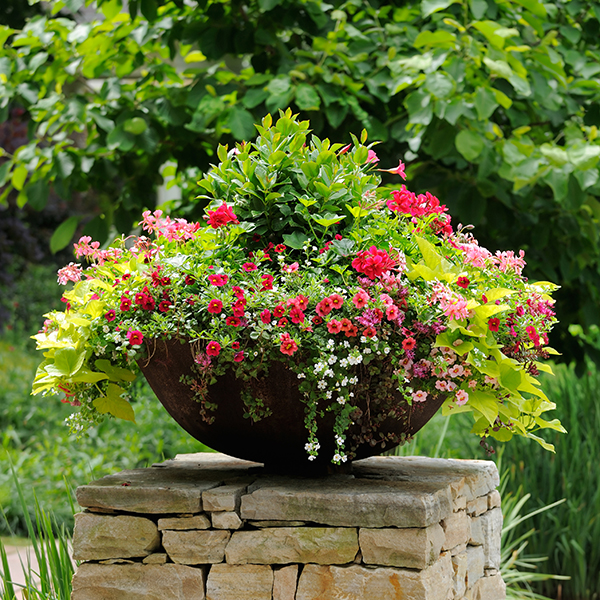
When you grow plants in pots or other containers, you’ll need to use different soil components than for plants growing in the ground. Ordinary garden soil is rarely suitable for those plants you grow in pots because they are too dense and poorly aerated and tend to dry slowly, becoming hard. This creates an unhealthy environment for potted plant roots.
Plants growing in pots need a soil (called a “growing medium” by nursery professionals) which is lighter in texture and drains well, but retains sufficient moisture and nutrients to satisfy plant needs. You want to have an environment where the roots can thrive, enabling them to support a healthy plant. For most potted plants growing outdoors I recommend using a soil-less mixture that includes peat moss, bark or other composted wood products and a component like sand or perlite that enhances drainage. How often you water your containers will depend upon the type of plant you’re growing and the condition of the growing medium – the faster it dries, the more frequently you’ll need to irrigate.
There can be advantages to using some garden soil in a container, provided the proportions are right. The clay content in garden soils is very effective for retraining nutrients, and also holding moisture. For many years professional nursery growers relied upon a classic container mix (sometimes called Cornell Mix) comprised of one third each sterilized garden loam, compost or peat moss, and sharp sand or pearlite for drainage. If you use this formulation, be sure to sterilize the soil (there are many ways to do this: see http://www.colostate.edu/Depts/CoopExt/4DMG/Soil/sterile.htm) to remove pathogens.